
Introduction from Elizabeth Casson Trust

Welcome to Personal Leadership for Occupational Therapists across health and care, independent and third sectors, and education and research. The Elizabeth Casson Trust is very excited to be funding this project, and for Fiona MacNeill to be delivering it together with her associates and alongside facilitators who have been previous participants in the programme. Fiona has provided valuable development support for occupational therapists in the past and we are sure this collaboration will create more opportunities for the profession in the future.
It’s possible you may be wondering who – or what – the Elizabeth Casson Trust is. Some of you may be familiar with the name of Dr Elizabeth Casson who, together with Margaret Barr Fulton, established occupational therapy in the UK almost a century ago. Dr Casson recognised the value of occupation for the recovery of individuals from ill health and made it her life’s work to embed this ethos in practice. She founded the first school of occupational therapy in 1930 and established the Trust that holds her name in 1948. What a person – and what drive, determination and leadership she showed. In fact, we interviewed her great-nieces as part of our 75th anniversary celebrations and you can read – and hear – the interview here.
You may also be wondering why the Elizabeth Casson Trust would commission this project. As custodians of the funds the Trust now holds, we aim to continue Dr Casson’s work to advance the profession, support the development of occupational therapists, and develop leaders. This programme will help create space and time for you, allowing the opportunity for constructive reflection, and through this new ways of thinking, doing and being can emerge.
We hope this experience is of value to you and we look forward to hearing the outcome of your work when someone from the Trust joins you for the last session of the programme.
Read a fascinating archive about Elizabeth and the start of our profession.
Introduction from Fiona MacNeill
My name is Fiona MacNeill, and I am going to be working in partnership with you on this programme. I am absolutely committed to creating space for us to have conversations, for you to challenge yourself and others, and for us to think creatively about your leadership and the impact of it. I am personally delighted to be part of this important programme and to learn with you as we work together over the next few months.
I have 30 years of experience and expertise in designing and facilitating learning and development – from community artwork and street work with drug users to large scale national leadership programmes for in excess of 3,000 people. Significantly I have supported the development of AHPs in Scotland for over 20 years.
Working closely in all of those systems with people at all levels of responsibility, from CEOs to frontline workers and with teams and individuals, my philosophy is that Leadership is a way of being, a set of thinking and behaviour that is aligned to values. It is not about management, position, status or experience – we are all leaders.
In this programme, I see my role as supporting you to think better for yourself. Everything we do together, and all of the tools, are based on underpinning theory, best practice and research.
All of that will be referenced for those of you who have that learning preference. However, it is not a PhD in Leadership, but a highly pragmatic and personal look at your leadership. It is about you: how you think and feel and how your thinking enables or gets in the way of you being the leader that you can be. It is very much a Strengths-based approach, focussing on what’s possible and challenging you to think differently.
You can learn more about me on my website www.fionamacneill.com
In the spirit of learning together,

Facilitation Style
I have the pleasure of co-facilitating this programme with colleagues from my team, and Health professional from across the 4 nations whose journey I have been part of. This is a group of people that I have chosen carefully to support your learning. We have shared values and ways of working.
We will co-create with you an Adult-to-Adult learning and development environment, and this will provide a space where real practical learning can take place. This learning will include challenge and support, fun and creativity, individual and group activities, and a need to be fully present and engaged.
My belief is that the first job we have as leaders is to create an environment where people can think for themselves. That is our intention and one that I hope you will replicate with your own teams as the programme develops.
The learning spaces that are shared will be held using ‘Rules of Engagement’, created by Nancy Kline. Nancy created and pioneered ‘The Thinking Environment’. Her book, More Time to Think, and the learning that I have done with Nancy has a significant impact on my practice.
Nancy has a few simple rules of engagement that really help to facilitate great conversations and create respectful learning environments, and these are part of how we work together:
- The development is facilitated as a Thinking Environment – requiring respect, personal integrity and rigorous confidentiality
- A commitment to arrive on time and be prepared
- One voice at a time, no interrupting – when we interrupt, we interrupt thinking as well as speaking
- Listen with attention, grace and ease; suspending voices of judgement, cynicism and fear
- We are thinking equals; candidates challenge the thinking of the facilitator and each other, and vice versa – the fundamental premise being that we help each other to think better for ourselves, not that we want to be right
- We help each other to grow – we offer honest and detailed feedback about the impact of learning and behaviour
From a facilitation point of view, this way of working requires highly developed skills and behaviours; the philosophy is an antidote to the old world and an invitation into the new, where:
- Relationships are everything; we need deep, honest, and authentic relationships with all of the people we work with, to engage with the emerging future
- Conversation, challenge, creativity and collaboration are the edges of all of the relationships in this learning environment
- You are as much the expert as I am, we are thinking equals
- Risk is shared in the adventure to explore the future and it is ok to be vulnerable
- Collectively, we are the work, we are the impact and we are the role models
- Listening is paramount; to self, to others and to the sense of the future
Programme Overview
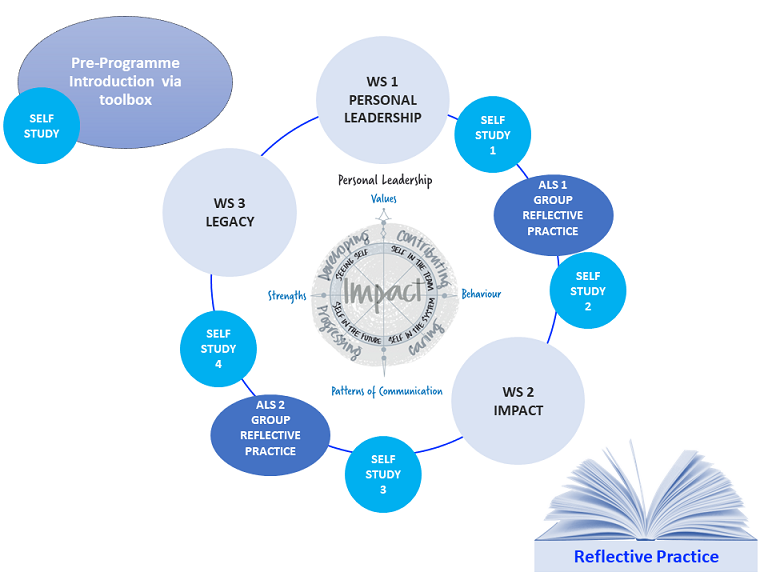
The personal leadership work to be completed in this programme is an opportunity to orientate yourself inside your leadership thinking.
Leadership is historically judged on actions taken. In large organisational systems, this is often influenced by the expectations of others, perceived norms and boundaries, and a culture of obedience.
This leads to the idea that where a few people are doing all of the thinking, most people are not. Without intention, this creates a culture of learned helplessness where thinking is not valued as much as action.
This programme invites you to consider a very simple observation: the quality of everything that human beings do depends on the quality of the thinking that we do first. The way we will work together on your Personal Leadership, and on the Mini Appreciative Inquiry where you will engage others, believes that the most important work that leaders have to do is to help people to think better for themselves.
The programme has 6 specific components:
- PERSONAL LEADERSHIP: Strengths based approach, Compass and Line Manager Interview
- COMMUNICATION: Values, Communication ,Assertiveness and Impact
- STRENGTHS: Thinking about your Strengths Profile, completing Strengths map and Sharing with Line Manager
- MINI APPRECIATIVE INQUIRY: Engage others by conducting a Mini AI
- CREATE: Creating your artefact of the programme
Importantly, the programme is designed as a Strengths Based approach to thinking about self, teams, and leadership. The key learning from ‘How Full is Your Bucket’ will underpin and drive what we do: Appreciation of Others/ Seeking and Providing Feedback/Positive and Outcome Focussed and Engaging Others.
The Blue Box Learning Space will walk you through the programme, providing underpinning knowledge and understanding. This, in turn, will be explored through 1-2-1 Thinking Partnerships that you have with another delegate, through self-study and facilitated Action Learning Sets.
You will have access to your facilitators between events through email and telephone. Finally, we have a YouTube channel where I will be uploading reflections and ideas to think about, and evaluation will be on-going throughout the programme.
Please read and follow this page down, watching all the videos and making notes before the Induction Session.
Listen to Stephen Covey talking about Circle of Influence
Thinking Space
This Personal Leadership Programme is built on the foundations of Thinking Space being created:
- by Fiona MacNeill for you and your colleagues
- by trained AHP facilitators for you and your colleagues
- by you for your Thinking Partner on the programme
- and most importantly by you for yourself
What does Thinking Space mean in the context of this programme?
- Thinking Space in groups; each group will have 7/8 OTs from Health and Social Care settings. The Action Learning Sets will enable you to listen to people who function in different parts of the system than you. To learn from their experiences and notice themes and differences.
- Thinking Space with a designated Thinking Partner; you will each be paired with another person on the programme. You will regularly think together about the tasks and challenges that the programme sets.
- Thinking Space helps you to get out of your own way.
- Thinking Space enables you to follow your thinking wherever it takes you.
Thinking Space for individuals will:
- Encourage directness, authenticity and personal accountability to hold up the mirror
- Assume that positive relationships are critical to success
- Give structure to the emotional dimension of thinking and the impact on personal effectiveness
- Explore assumptions and clarify decisions that the individual wants to make now
- Surface doubts and concerns, blind spots and unintended consequences
- Create the thinking that leads to real development and change for the individual
Thinking Space is typified by:
- The thinker thinking for themselves. It’s for anyone who wants to create the space to think and think differently
- The thinking partner acting as a custodian, taking care of the thinking through attention, appreciation and ease. Our only objective is to help you to think better for yourself
- The use of a specific framework for inquiry – including the Appreciative Inquiry 4D model and patterns of questions based on the work of Nancy Kline – designed from theory applied in practice
Useful for
- Encouraging directness, authenticity and personal accountability, holding up the mirror
- Assuming that positive personal and team relationships are critical to business success
- Giving structure to the emotional dimension of your thinking and the impact on your effectiveness
- Exploring assumptions and clarify decisions that you want to make now
- Surfacing doubts and concerns, blind spots and unintended consequences
- Creating the thinking that leads to real development and change
Resource: Thinking Space
Helpful additional information
Some fantastic clips of Nancy Kline speaking about what has inspired her work on Thinking Environments: https://www.timetothink.com/media/